At the age of 18 I co-founded an AI startup with teenagers from all across the world that I have never personally met. Here’s how I created an internet network since I didn’t have one
 ahamedabubakkar35@gmail.com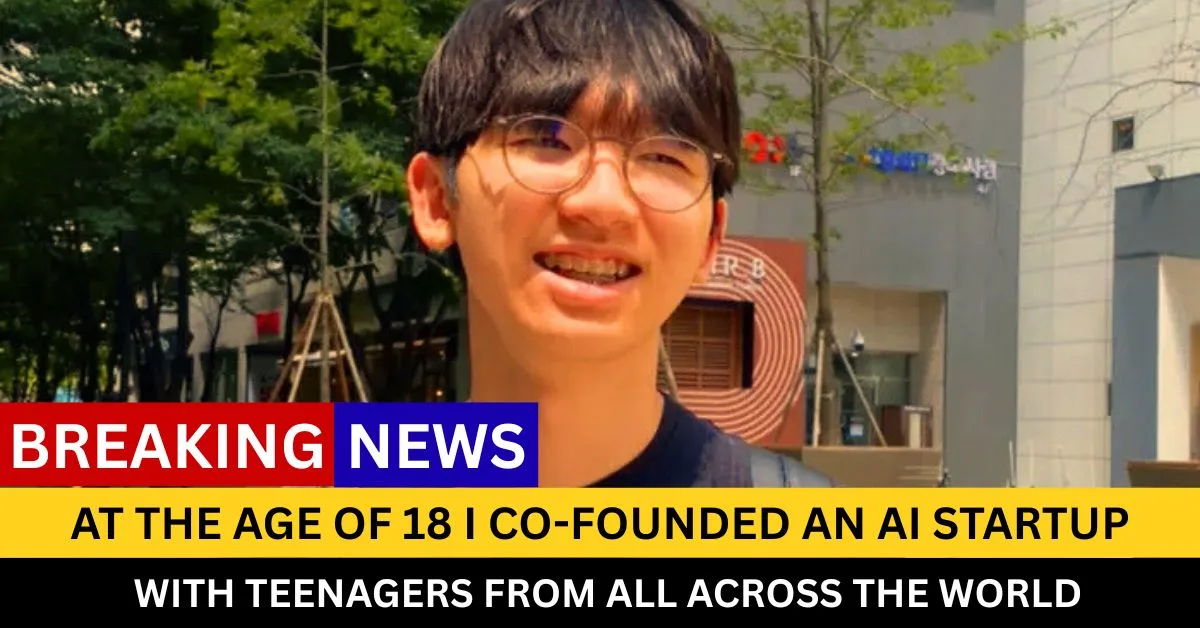
At the age of 18 I co-founded an AI startup with teenagers from all across the world. CREDIT: Alex Yang founded a startup with other high schoolers he met online. Courtesy of Alex Yang
Discover how At the age of 18 I co-founded an AI startup with teenagers from all across the world. I usually get up about three in the morning. I immediately receive GitHub pings from Florida, Messenger messages from web developers in California, and a running document of research papers to read from Michigan. by 7:50 a.m. I’m heading to class to live my life as a senior in high school in Seoul at the age of eighteen. Since I started an AI research and development firm with folks I’ve never met in person from all over the world, this solitary ritual has become my weird normal. Since I had no network, I created one online in order to fulfill my goal of improving Alzheimer’s diagnosis.
- At just 18, Alex Yang founded an AI startup after connecting with like-minded students from around the world through online platforms.
- The student-led team is using artificial intelligence to improve early diagnosis and detection of Alzheimer’s disease.
- The startup has launched an AI-powered therapy solution designed to help Alzheimer’s patients strengthen memory recall and cognitive function.
Alzheimer’s has always seemed like a horrible illness to me
At the age of 18 I co-founded an AI startup with teenagers from all across the world. I grew up hearing tales of family members suffering from Alzheimer’s. I saw the illness as something genuinely horrifying, leaving just the shell of a person’s former self.
Growing up, I was aware that one day a loved one might vanish while still in front of me. This fear solidified into something more than passive acceptance during high school. I chose to enter after finding this competition, which aims to provide funding for concepts that can improve health accessibility.
I was aware that I couldn’t do the task by myself. I had to look outside of my network for people with different viewpoints and abilities who could work with me to create something genuine.
I began looking for partners by pitching my idea and spending time on online forums. I made GitHub repositories with draft code and shared comprehensive research suggestions on Discord servers.
I received one “yes” from California after a month of “nos.” Florida came next. Next, Michigan. Up until there were six of us. We purposefully used wordplay in our name, Reteena (pronounced “retina”), to represent our goal of bringing fresh perspectives to Alzheimer’s diagnoses.
We turned into a group of high school students from all over the world who sincerely thought we might cure Alzheimer’s, something none of us had anticipated.
My group and I made the decision to increase the affordability and accessibility of Alzheimer’s diagnoses
Although I wasn’t specifically targeting high school students, those were the ones who answered because I was on servers mostly for students.
Self-funded, we began by investigating ways to improve the picture resolution of low-field MRI, a more affordable and portable MRI machine. To improve the quality of low-field MRI scans, we used deep learning and machine learning approaches.
Our ambitious objective was to improve the reliability of low-field MRI in order to make Alzheimer’s diagnosis more accessible and inexpensive for underprivileged areas. As we conducted research together, I came to the realization that my abstract fantasy had come true, but reality turned out to be far more difficult than any dream.
I began to question my ability to lead
The overwhelming amount of time and effort that my team was putting in made me stumble. I didn’t use the time zone difference as a justification for keeping them waiting for answers. As I lay awake at night, worrying about “what should I do next,” I realized that making the incorrect choice could squander months’ worth of effort from those who supported me.
I would doubt everything my skills, our direction, and whether I was deserving of the trust my team had in me during those oppressive times when uncertainty was a tangible ache in my chest.
As I began to perceive our differences as assets rather than barriers, my leadership gradually improved and my fears subsided. Using thorough handoff documentation in shared Notion workspaces, I established a “follow-the-sun” approach in which I finished things before Americans woke up. Despite being asynchronous, we felt more linked in some way.
Also read: Do these 6 easy steps to be taken Startup seriously: According to executive coach, “99% of founders” don’t.
The assurance I needed to keep going came when we were published
I was thrilled when our first study was presented at the esteemed yearly meeting for artificial intelligence research, the IEEE BigData 2024 meeting. It was evidence that we were on the right track and a reason to stay up late every night. But that was just the start.
We grew from a six-person group chat to a 12-person unorthodox startup. We carried out more study on Alzheimer’s over the course of the following nine months, presenting our findings on how alterations in speech patterns and genetic markers could help identify the disease earlier than conventional techniques.
Since we met online, we have also shared our story on LinkedIn and made our development public online. We made connections with mentors who supported our work by sharing our product-building journey and the genuine reasoning behind our research and products. These mentors included Pear VC partners, Y Combinator founders, and researchers who took us seriously despite our advanced age.
Students from all around the world began messaging us to seek for help launching their own health technology initiatives.
Our first product has been released
In an effort to assist Alzheimer’s sufferers in reestablishing a connection with their past, we most recently introduced Remembrance, our first consumer product, an AI therapeutic service. Through recollection therapy, it operates by posing gentle inquiries intended to elicit memories from the past.
It is simple to revisit and create a personal memory repository because each recalled memory is automatically arranged in knowledge graph databases. It can eventually create a customized memory repository by making on-demand recommendations for linked experiences.
In many respects, the healthcare industry is unbreakable. We tried to contact a nearby hospital to test our solution with real patient data, but institutional review boards and compliance standards stopped us right away.
I’m appreciative All of this was taught to me in high school, when the stakes were smaller
It has taken us two years to realize that creating something in the healthcare industry is more difficult than we anticipated. However, we learned that at the ages of 17 and 18, not at 25, when the stakes are bigger and the anxiety is greater, so I wouldn’t alter it.
It’s okay if Reteena doesn’t turn out the way we had hoped. Learning how to construct, seeing that actual problems matter more than viral success, and realizing that you can inspire people by just attempting were all more important than the final destination.
The actual experiment is that. And every restless night is worthwhile.
About The Author