Ynsect a French business that had raised over $600 million for insect farming, was crushed by reality
 ahamedabubakkar35@gmail.com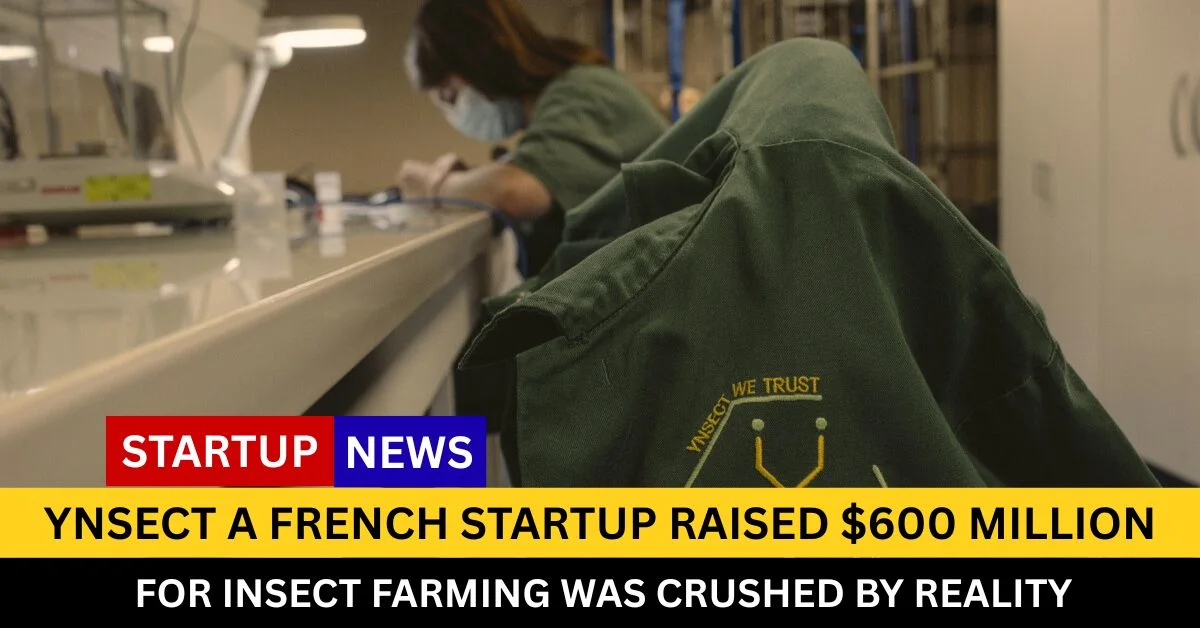
Ynsect a French business that had raised over $600 million. CREDIT: Ÿnsect
Learn how Ynsect a French business that had raised over $600 million. When “Iron Man” actor Robert Downey Jr. promoted the French startup ynsect on the “Late Show” over Super Bowl weekend 2021, it surged to prominence. The insect farming business has now been placed in judicial liquidation, which is effectively bankruptcy for insolvency, after almost four years. Given that the company had been struggling for months, its downfall is hardly shocking. There is still much to learn about how a firm can fail even after obtaining more than $600 million, including from taxpayers, Downey Jr.’s FootPrint Coalition, and numerous other sources.
- French insect-farming startup Ynsect raised over $600 million from investors but has now entered judicial liquidation, effectively marking bankruptcy.
- Despite global attention and celebrity backing, including promotion by actor Robert Downey Jr., the company struggled to make its business model viable.
- Ynsect’s downfall highlights how even heavily funded climate and agri-tech startups can fail when scale, costs, and market realities don’t align.
Ynsect was unable to achieve its goal of using insect-based protein
In the end, Ynsect was unable to achieve its goal of using insect-based protein to “revolutionize the food chain.” However, don’t jump to the conclusion that the “ick” factor that many Westerners have for bugs is the reason for its failure. Its primary goal was never human food.
Rather, Ynsect concentrated on making insect protein for pet food and animal feed, two industries with drastically different economics and profit margins that the business was never able to decide between.
Its M&A strategy was also affected by this hesitation. A third market was added in 2021 when Ynsect purchased Protifarm, a Dutch business that raised mealworms for use in human meals. Then-CEO Antoine Hubert acknowledged that it would take a few years for human food to account for just 10% to 15% of Ynsect’s revenue, even as the business announced the arrangement.

We still see pet food and fish feed being the largest contributor
At the time, Hubert said, “We still see pet food and fish feed being the largest contributor to our revenues in the coming years.” Put another way, at a time when the startup was in dire need of revenue growth, Ynsect was purchasing a business in a market area that would stay marginal for years.
And the issue was revenue. Ynsect’s revenue from its core business reached a peak of €17.8 million (about $21 million) in 2021, according to publicly available data; this amount was allegedly exaggerated by internal transfers between subsidiaries. The company’s net loss by 2023 was €79.7 million ($94 million).
How, then, did a business with such low income generate more than $600 million? Ambitious multiples paid by hype-driven crossover funds during the 2021 financing frenzy were not the solution. Rather, Ynsect drew impact-oriented investors who were drawn to its attractive sustainability agenda, such as Astanor Ventures and public investment bank Bpifrance.
Offering a substitute for resource-intensive proteins like fishmeal and soy was its straightforward pitch to them. Additionally, that same thesis drew substantial funding from rivals like Better Origin and Innovafeed, and it appeared promising.
The market realities and the vision clashed
However, the market realities and the vision clashed. Price, not sustainability premiums, drives the animal feed business. In a perfect world, insects would consume food waste that would otherwise end up in landfills, making insect protein completely circular. However, in reality, the production of insects on a large scale usually relies on grain by-products that may already be used as animal feed; insect protein is only an additional, costly step. The math just didn’t work for animal feed.
Eventually, Ynsect realized this. Pet food turned out to be a different story: despite competition from other alternative proteins like lab-grown meat, it is a far better market for insect protein and is less price-driven than animal feed. Hubert cited broader economic headwinds as the reason why the firm refocused its strategy by 2023 on pet food and other higher-margin categories.
Hubert stated at the time, “We cannot afford to invest a lot of resources in markets that are the least lucrative (animal feed), while there are other markets where there is a lot of demand, good returns, and higher margins, in an environment where there is inflation on energy and raw materials as well as on the cost of capital and debt.”
It was too late to switch to pet food in 2023. By that point, Ynsect had already made a huge, capital-intensive wager that would ultimately bring the company to ruin. That wager was Ònfarm, a Northern French “giga-factory” marketed as “the world’s most expensive bug farm.” The facility, which was designed to produce insects on a large scale, required hundreds of millions of dollars in finance before Ynsect had established its business plan or determined its unit economics.
Ynsect hired Shankar Krishnamoorthy, a veteran executive at the French energy firm Engie, to manage the launch of Ynfarm. Krishnamoorthy took Hubert’s place as CEO after the company’s attempt to save itself with pet food failed.
After that, Ynsect reduced employment and closed the production facility it had purchased from Protifarm. However, the underlying issue could not be resolved by closing one facility while running a giga-factory designed for the incorrect market.
“Ynsect’s struggles are not a mystery and are not primarily about insects,” according to Professor Joe Haslam, who teaches a course on scaling up in the MBA program at IE Business School. They are the outcome of a mismatch between timing, capital markets, and industrial ambition, which is exacerbated by certain execution and strategy decisions.
The failure of Ynsect does not portend the demise of the insect farming industry as a whole. According to reports, rival Innovafeed is doing better, partly because it began with a smaller production facility and is gradually expanding.
Ynsect is an example of a larger European issue, according to Prof. Haslam. “Ynsect is an example of the scaling gap in Europe. Moonshots are funded by us. We don’t adequately fund factories. We honor pilots. We give up on industrialization. See Volocopter, a German air taxi startup, Lilium, a failed German flying taxi company, and Northvolt, a failing Swedish battery manufacturer,” he stated.
Some introspection has been sparked by the setback. In understanding that Europe requires more than just cash to develop the next generation of deep tech firms, Hubert himself co-founded Start Industrie, an organization that advocates for policy to help French industrial entrepreneurs.
About The Author


