Trump’s aides persuaded him that he performed admirably after he denied economic realities in a prime-time speech.
 ahamedabubakkar35@gmail.com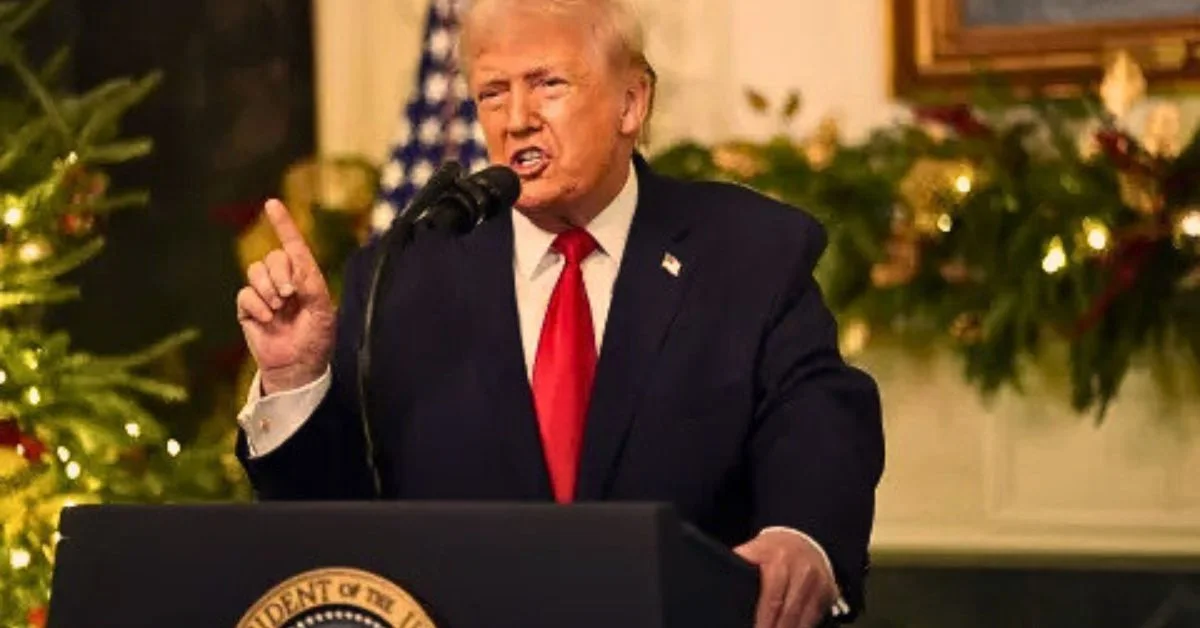
Trump's aides persuaded him that he performed admirably.
Trump’s aides persuaded him that he performed admirably. In a politically tense speech that was broadcast live in prime time on network television on Wednesday, President Donald Trump announced that he would be giving U.S. troops a $1,776 bonus check for Christmas and attempted to blame Democrats for economic difficulties.
Despite the fact that the country is getting ready to enjoy the holidays, Trump’s comments focused more on national tensions than on unity. His address was a repetition of his recent messaging, which hasn’t been able to allay public concerns about the price of necessities like groceries, housing, and utilities.
Despite Trump’s promises of an economic boom, the job market has drastically declined following his import levies, and inflation has remained high. Trump claimed that a new “warrior dividend” for 1.45 million military personnel would be funded by his tariffs, which are partially to blame for the increase in consumer prices. This payment could alleviate some of the financial burdens on many people. The sum of $1,776 was an allusion to the 250th anniversary of the Declaration of Independence’s signing the following year.
Regarding the expense, which would come to almost $2.6 billion, he stated, “The checks are already on the way.”
Rally speeches are often more partisan than presidential addresses to the country broadcast on network television, but Trump delivered a distilled version of his customary political remarks.
In the Diplomatic Reception Room of the White House, with a portrait of George Washington behind him and two Christmas trees on either side, Trump attempted to blame his predecessor, Joe Biden, for any economic concerns.
“I inherited a mess eleven months ago, and I’m fixing it,” Trump declared. “The world is about to witness an unprecedented economic boom.”
Trump wants to reverse the decline in his popularity.
His holiday greetings arrived at a pivotal moment in his efforts to restore his slowly declining reputation. According to public polling, the majority of American adults are dissatisfied with his management of the economy as hiring slowed and inflation increased as a result of his tariffs.
As the country prepares for the midterm elections that will determine control of the House and the Senate in 2026, Trump and his party will be subject to a referendum on their leadership.
After Republican defeats in this year’s elections prompted concerns about the longevity of his coalition, Trump used the White House comments as an opportunity to try to restore some momentum. Despite media networks’ previous reluctance to broadcast presidential addresses full of campaign-style rhetoric, he publicly leaned into politics.
For instance, networks refused to grant the Biden White House a prime-time time slot in September 2022 for a speech the then-president gave about democracy because they thought it was too political.
With a tone that occasionally verged on rage, Trump spoke at a fast-paced speed. In response to the public’s dissatisfaction with the economy this year, Obama made even more audacious growth promises for the following year, stating that mortgage rates will drop and that he “would announce some of the most aggressive housing reform plans in American history.”
Trump used graphics to support his claim that the economy is expanding. He asserted that international leaders had told him that “we’re the hottest country anywhere in the world,” a claim he has repeatedly made at public gatherings, and that incomes were rising, inflation was decreasing, and investment dollars were flooding the nation.
If the argument looked similar, it is because it is reminiscent to Biden’s unsuccessful argument regarding the US economy. In the face of inflation, he also cited the U.S. economy’s impressive growth rate in comparison to other countries.
Also read: This is the amount that traders anticipate Micron stock to move following earnings. Wednesday.
The public and Trump have different perspectives on the economy.
The public’s internalized hard math presents a more nuanced picture of an economy with some stability but few reasons to inspire popular confidence.
Gas prices are falling, the stock market is rising, and tech corporations are making big investments on the advancement of artificial intelligence.
However, since Trump announced his tariffs in April, inflation, which had been declining after rising to a four-decade peak in 2022 under Biden, has increased again. The yearly growth rate of the consumer price index has increased from 2.3% in April to 3%.
The deteriorating job market is another factor contributing to the affordability strain. Since April’s “Liberation Day,” when Trump imposed import levies that he later halted and then readjusted several months later, monthly employment increases have averaged a pitiful 17,000.
From 4% in January to 4.6% now, the jobless rate has increased.
According to Trump, investment commitments for new factories will expand manufacturing jobs, and when consumers receive larger tax refunds in the upcoming year, consumer activity will significantly improve.
Trump is seen favorably for stopping crossings along the U.S. border with Mexico, but his mass deportations of immigrants have proven to be controversial. His worldwide attempts to put an end to disputes and his attacks on suspected drug vessels close to Venezuela have mostly gone unnoticed by the public.
As the subsidies associated with the 2010 Affordable Care Act are about to expire, Trump attempted to hold Democrats responsible for the anticipated rise in health insurance costs. Trump has resisted efforts by Democratic lawmakers and some Republicans to address that issue, arguing that payments should be sent directly to health insurance consumers rather than the firms. The president has not yet pledged to support a particular legislative solution.
When his speech was over and the video had stopped airing, Trump asked his assembled aides how his speech to the country had gone. The assistants told him it was fantastic.
Then, Trump said that Susie Wiles, the chief of staff at the White House, had informed him that he had to speak to the country. He asked Wiles how he was doing after some back and forth.
“I told you twenty minutes, and you were exactly twenty minutes,” Wiles remarked.
About The Author