After leaving Mumbai to become a beekeeper meet this Bollywood editor founded Amar Honey startup, a 100% natural honey company that currently makes 35 lakhs a year
 ahamedabubakkar35@gmail.com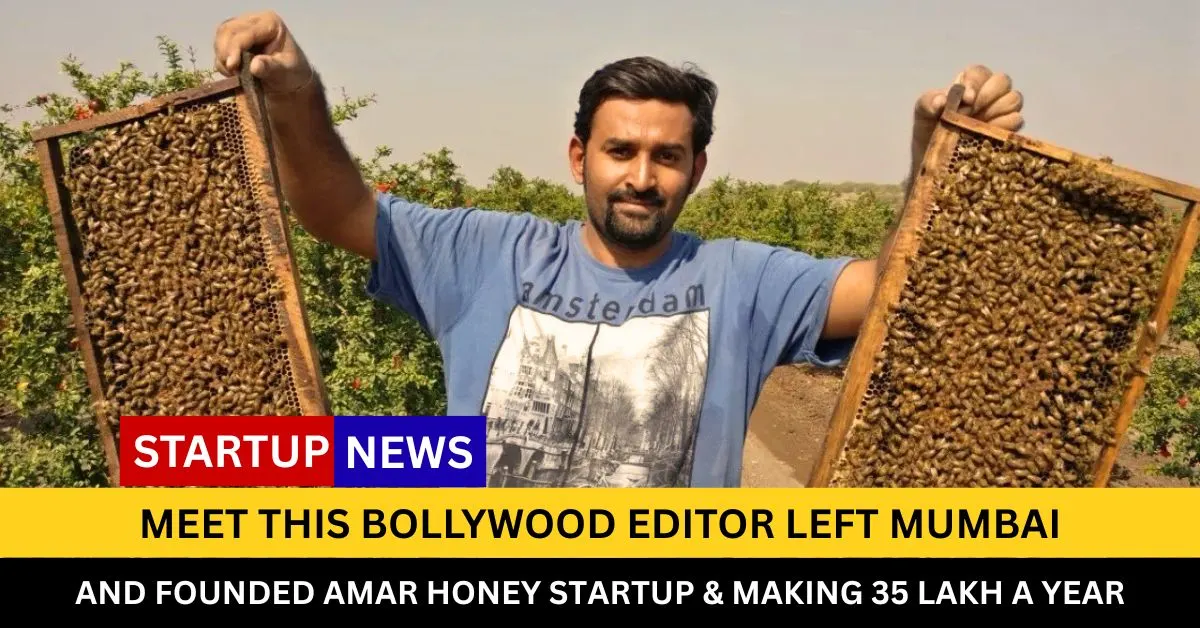
After leaving Mumbai to become a beekeeper meet this Bollywood editor founded Amar Honey startup. CREDIT: Amar Honey Founder
After leaving Mumbai to become a beekeeper meet this Bollywood editor founded Amar Honey startup from Gujarat who is now making 35 lakhs a year as a honey entrepreneur. He founded his own company after returning from Mumbai.
“I didn’t want to become enmeshed in the city’s rat race, where you’re so busy that you don’t realize you’ve turned fifty.” These are the comments of Brijesh Kalariya, a Bollywood editor from Gujarat who became a honey entrepreneur after quitting his lucrative, glamorous job in Mumbai to pursue a rural lifestyle and provide for his family during a difficult time.
The IMARC Group projects that the apiculture industry will reach around Rs 68,182 million by 2033, up from Rs 28,394 million in 2024. Brijesh Kalariya saw this new possibility in 2015–16, when honey bee farming was only starting to gain popularity in Gujarat. In an effort to meet the increasing demand for pure, naturally produced honey, he founded Amar Honey at this time.
Concerning Brijesh’s Past
Brijesh, who is from Gondal in Gujarat’s Rajkot district, earned his Bachelor of Computer Applications at Pune, Maharashtra, in 2010. After completing a two-year course in animation and cinematography, he went on to work in Mumbai’s media sector, focusing in studio production and film editing.
His main job was to create animated characters and edit uncut footage. He claimed to have helped with the 3D conversion of the famous movie Titanic, which debuted in India in April 2012. He also contributed to a number of other Hollywood projects, Mentos commercials, and the development of the “Bade-Chote” characters for Bakwas Band Kar on 9XM.
He realized that contentment and serenity are more important than wealth or prestige, but despite this achievement, he thought his existence there was meaningless.
“I didn’t want a life in which the days went by and you realized all of a sudden that you were fifty. I desired a fulfilling life. I wanted to work joyfully and with real passion in anything I did. In an exclusive interview, Brijesh told Indifact News.
The Story of Brijesh’s Family and His Initial Attempts in Apiculture
For almost 40 years, Brijesh’s father has run a company selling electronics and household goods. Ancestral agricultural property is also owned by the family. This land was usually farmed by his father, but it rarely produced any substantial revenue. In early 2013, Brijesh made the decision to return to his village after witnessing this struggle and the stress of a busy life in Mumbai.
For Brijesh, 2013 was a pivotal year. He became aware that consumers nowadays aren’t receiving high-quality food and agricultural products when he began to approach farming from a business perspective rather than merely a traditional one. There was undoubtedly a market for them if they could develop high-quality agricultural products with strong earning potential.
Using YouTube as his main educational resource, he started looking into other ways to boost their agricultural income. “YouTube was my first teacher,” Brijesh remembers. “Over the course of two days, I watched films about raising our revenue for eighteen hours straight. I learned around 70% of the fundamental information required to work in the apiculture industry from those films,” Brijesh told Indifact News.
Brijesh’s First Agroforestry Model Experiments
Brijesh and his father once talked about whether it would be preferable to sell their land and put the proceeds in a bank for ten to fifteen years. They quickly realized that selling the land was not the best option, despite the fact that it was not producing revenue. Rather, they believed it should be put to good use, particularly at a time when nutrition and food quality were progressively deteriorating.
They started experimenting with an agroforestry model in 2014–2015. Neem, Sheesham, and Melia were among the 800 trees they planted. As a result, they learned that planting trees may provide carbon credits and provide raw materials for the plywood sector. In addition to promoting environmental sustainability, this approach provided partial returns in five to six years.
They experimented with black haldi, black turmeric, drumstick, seedless lemon, sandalwood, and fodder crops alongside Melia and Neem. It was to be expected in the early learning stage that certain crops would do better than others.
Growth and Education
The maturity cycles of various crops varied. To attain full value, some took three years, some six, and some even 10 or fifteen.
Trees chopped after two years, for instance, could only be used for firewood; trees cut after six years could be used to make plywood. Premium-quality wood was created by trees that were cultivated for ten to fifteen years. After six years, they finally harvested the trees and sold them for Rs. 10 per kilogram. The wood was gathered and processed by the plywood industry, which made about Rs. 4.75 lakh. They also started cultivating honey to diversify their sources of income.
The Amar Honey Story
When Brijesh began cultivating honey in 2016, very few people in the state knew how important it was and how much money it could make. Almost all of his business is done through word-of-mouth advertising and WhatsApp. He makes and sells honey under the brand name “Amar Honey.”
95% of prosperous, educated individuals have no idea what real honey is. Brijesh told Indifact News, “Our job is to tell you the reality, not to sell honey.”
He goes on to stress the significance of determining the actual characteristics of genuine honey. He claims that crystallized honey is a common myth in India.
“Honey is pure and contains natural glucose from the flowers if it crystallizes. This method is a sign of purity and is entirely natural. Its high glucose content and purity are demonstrated when it crystallizes. Brijesh continued, “This is a positive sign, not a negative one.
Early Growth and Investment
Brijesh invested about Rs. 40,000 to start Amar Honey with ten bee boxes. Since blooming availability is crucial for honey production, the boxes were positioned on agricultural land where tur (pigeon pea) crops were growing. Bee productivity varies with the seasons and crop types, and they are totally dependent on adjacent flowers.
Brijesh was finally certain that he was headed in the right direction after the first good harvest. In 15–20 days, he extracted about 18 kg of honey from the first ten bee boxes. He made Rs. 10,800 by selling this honey for Rs. 600 a kilogram.
Growth of Amar Honey
He started relocating the boxes to various flowering zones as production grew. Depending on crop cycles, the boxes were moved every few days since bees needed fresh flowers to create high-quality honey. After that, he gradually increased to 50 and eventually 120 boxes.
It became challenging to handle everything on your own at this point. He employed and educated a number of workers who assisted with day-to-day tasks including moving boxes, keeping an eye on the health of the bees, and extracting honey. He was able to concentrate on long-term planning, client communication, and quality control as a result.
Current Capacity, Business Model, and Revenue
Compared to market honey (Rs 300-450/kg), Amar Honey is offered directly to consumers via WhatsApp and personal networks for Rs. 600-800 per kilogram. In addition to honey sales, bee box sales through colony expansion, pollination services, and farmer training generate income.
Despite having a capacity of 6,000–7,000, Brijesh oversees 500 boxes, putting quality before quantity. He makes about 5,000 kg of honey a year from these boxes, earning between Rs. 35 and Rs. 40 lakhs.
“We could handle 6,000–7,000 crates, but why? The boxes must be kept in line with consumer demand. Since the beginning, we have concentrated on that since there is no purpose in providing them with the incorrect item or a subpar quality. Brijesh told Indifact News.
Considering the Future
The strategy going forward is to collaborate with specific farmer groups, assist them in implementing the same methods, and gradually raise output without sacrificing purity. Educating more people about authentic honey, healthy soil, and sustainable farming is the aim at the same time.
He is also open to branching out into additional honeybee-derived goods like propolis, royal jelly, beeswax, bee venom, and pollen. These by-products enable better usage of the entire beekeeping environment and have significant medical, cosmetic, and pharmaceutical value.
Brijesh concluded by telling prospective honeybee farmers that a connection to nature is essential to agriculture. “Working in agriculture requires more than just money.” Agriculture has a close relationship with nature, regardless of your financial situation. You shouldn’t go straight into agriculture if you haven’t worked with nature before. It takes over ten years to obtain that experience.Brijesh remarked.
About The Author