Meet this 28 year old CS graduate who created a platform for authorized product sourcing that resembles Pinterest and serves over 1100 users every day
 ahamedabubakkar35@gmail.com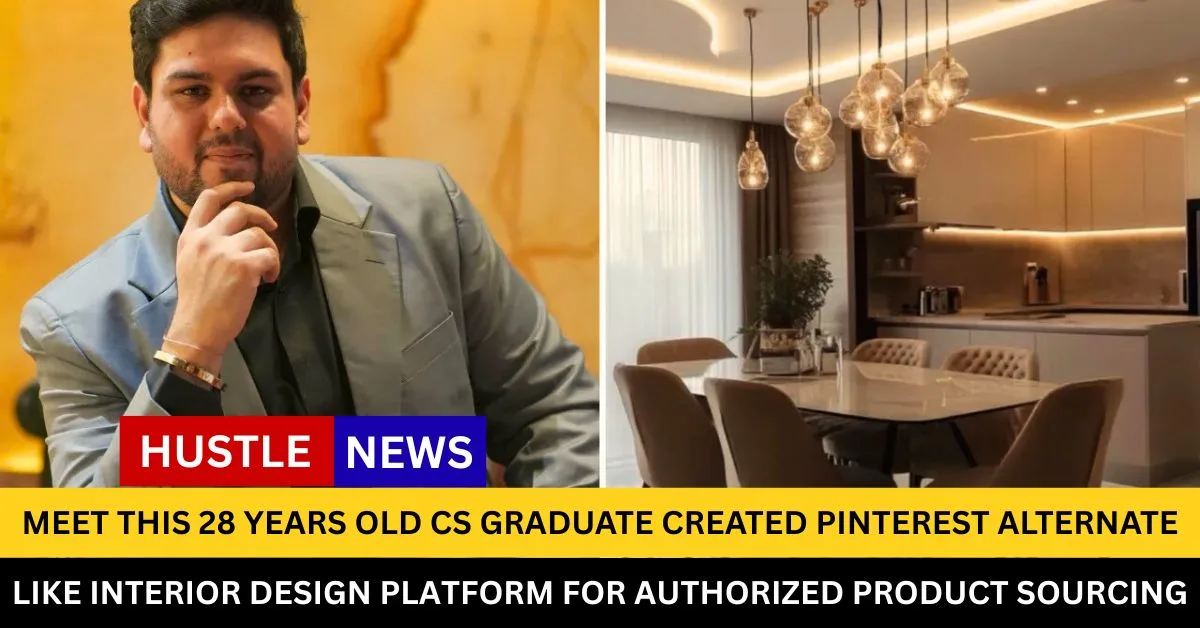
Meet this 28 year old CS graduate who created a platform. CREDIT: Pratit Biscuitwala, entrepreneur and founder of Think Home
Meet this 28 year old CS graduate who created a platform. ThinkHome is a Mumbai-based firm that was founded in 2025 with the goal of using verified dealers, pricing, and a trust-first approach to solve India’s interior material procurement issue.
You’ll hear the same sigh before the narrative starts if you ask anyone who has remodeled a house in India.
“Italian quality was promised to us.”
“What arrived did not look like the sample.”
The dealer claimed that the plywood was watertight. It wasn’t.
“The brand label appeared correct. However, something didn’t feel right.
Purchasing furniture, fixtures, lights, or even something as basic as plywood is a leap of faith for many people in the Indian market, where home ownership is a very emotive issue and home design projects represent the lifelong savings of many people. The multibillion-dollar Indian house design sourcing market is a highly fragmented, opaque, and trust-based industry that is expanding quickly.
“You can’t just Google ‘plywood dealer Delhi’ and trust what you find if a project site is in Delhi and you’re based in Mumbai,” ThinkHome founder Pratit Biscuitwala says in an exclusive interview with Indifact News.”You have no idea whether the product is authentic, whether the dealer is authorized, or whether the promised specifications are even true.”
Pratit Biscuitwala, a computer science graduate who chose to forgo a traditional career path in favor of starting a start-up company, founded ThinkHome, a cutting-edge online interior design sourcing platform, in response to this gap, which was felt not on a theoretical level but on actual project sites.
How the Indian interior design sector functions
Brands, distributors, dealers, contractors, and interior designers interact intricately to provide the necessary services in India’s interior design sector. The final experience has not yet been regulated, despite the fact that foreign brands actively participate in this market.
In the industry, rebranding products, substituting materials, inflating prices, and making false promises are commonplace, particularly in sectors like lighting, furniture, sanitary ware, and plywood. The problem becomes much more difficult for the homeowner in Mumbai, the designer handling multiple projects that are spread out geographically, or the buyer for the project in Delhi.
Portal services like Justdial and IndiaMart exist, but their business structures prioritize listing over validity. Individuals must pay for their listing, but not for its verification. A huge number of unqualified leads are produced. As an alternative to this model, ThinkHome was established in 2025. With verified dealers, pricing, and a trust-first approach, this Mumbai-based firm seeks to solve India’s interior material procurement issue.
Pratit Biscuitwala is who?
India is where Pratit Biscuitwala was born and reared. In 2016, he finished his Cambridge A-Levels at Podar International School. He relocated to the United States to pursue an undergraduate degree in computer science at California State University, East Bay since he had a strong interest in technology.
Pratit shared the desire of many overseas students to pursue a career in technological innovation. However, the COVID-19 pandemic started at the same time that he graduated. He returned to India due to global unpredictability and started working for Infibeam Avenues, the fintech firm behind CC Avenue, one of the country’s biggest payment gateways.
Even though the position exposed him to extensive digital infrastructure, Pratit began to doubt the traditional course. In an open discussion with Indifact News, he remembers, “I had spent a lot on my education.” “And somewhere, I felt that I wanted to create something of my own, something that truly solved a real problem, rather than working at a job for a long time.”
That issue came up considerably closer to home than he had anticipated. An interior design company is operated by Pratit’s brother. Sourcing materials should have been simple on paper. It wasn’t at all what it seemed.
- Credibility was just as much of a barrier as price.
- Customers and designers were spending an excessive amount of time confirming sellers.
- Verifying statements twice,
- and continue to receive conflicting answers.
There was no technology-based infrastructure specifically for authorized sourcing to go along with the existence of high-quality brands. This insight ultimately served as the foundation for ThinkHome.
How ThinkHome Operates
ThinkHome was founded in 2024 and took roughly eight months to create internally. The website, iPhone app, and Android app were developed by Pratit, while his brother contributed domain expertise and made an investment in the company.
The strategy was straightforward and successful:
Create a marketplace where customers may browse home goods like a Pinterest-like inspiration board, and only communicate with vendors that have been certified.
ThinkHome flipped the business paradigm by focusing on companies that refused to divulge dealer information. The group started by giving category-exclusive access to approved dealers and onboarding them themselves. “We won’t list Kohler through anyone else if you’re an authorized Kohler dealer on our platform,” Pratit told Indifact News. You get all Kohler inquiries.
ThinkHome is not an online store
For excellent reason, ThinkHome is not an online store. Customers use the platform in a manner similar to that of Pinterest. They can see furniture, lamps, fixtures, and couches together with their specs and estimated costs. They can use just their name and phone number to make a straightforward inquiry if they like anything.
The customer is then contacted by the authorized dealer. The following is ThinkHome’s guarantee: Each dealer on the list has been vetted and approved by the brand they represent.
In his open discussion with Indifact News, Pratit emphasized that “scams happen everywhere in the interiors space.” “A Chinese couch is rebranded. When a ply is not waterproof, it is marketed as such. Lighting items are also exchanged. We get rid of that danger.
ThinkHome has a pay-per-lead business strategy. For each qualified lead, dealers pay a fixed ₹200. No commissions on sales value, no premiums, and no subscriptions. “We don’t take a cut whether the dealer sells ₹50,000 worth of material or ₹25 lakh,” Pratit claims.”Delivering real, high-intent leads is our only priority.”
Leads are typically well qualified since clients view complete product details prior to placing an inquiry.”A person is already serious if they fill out the form after reading the specs and pricing,” he continued.
On October 3, 2025, ThinkHome made its formal debut. Social media and natural outreach provided early traction. However, Pratit views this as a stage of education. He explains to Indifact News, “We’re still finding our feet.”The largest obstacle at the moment is awareness. People are still unaware that such a site exists. Though expansion is already planned, ThinkHome is now strongest in Mumbai.
What will ThinkHome do next?
With an emphasis on creating city-specific dealer networks and a future pincode-based sourcing strategy, cities like Delhi, Bengaluru, and Chennai are the next. WhatsApp-based assisted sourcing is one of the most promising new capabilities. Understanding that perusing 5,000 items can be daunting, ThinkHome has hired in-house interior designers to assist customers in choosing things at no cost.
“Our designers will recommend products directly from our platform and even raise inquiries on their behalf if someone wants to renovate a living room,” Pratit says. According to Pratit Biscuitwala, “we are bootstrapped and our tech costs are manageable.” “We are constructing this for the long haul. Vanity metrics are not what we are pursuing.
Pratit has a clear objective: create the first reliable, tech-driven interior sourcing platform in India that is solely concerned with authorization, transparency, and trust.
About The Author