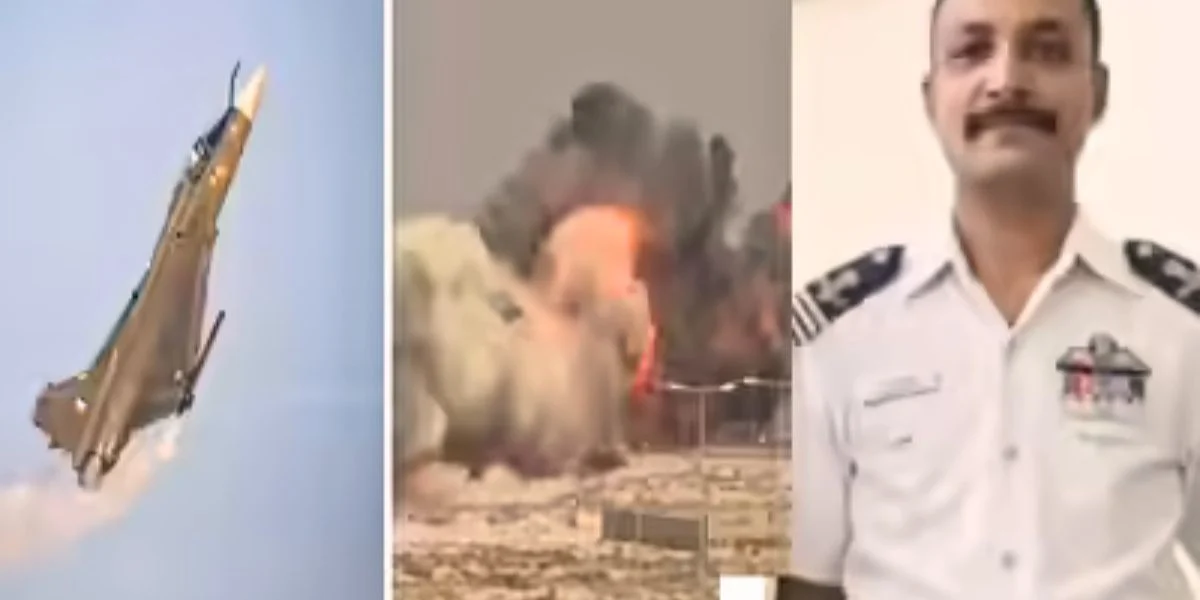
The Tejas Dubai crash loss of Wing Commander Namansh Syal in Dubai on Friday was a tragedy for the whole IAF community as well as the entire country. Sayal was using the Tejas Light Combat Aircraft (LCA), manufactured by HAL, for a low-level aerial demonstration. It was Sayal’s last trip before the ship back home, and it was the last day of the biennial Dubai Air Show at Al Maktoum International Airport.
To demonstrate India’s domestic defense capabilities, particularly the Tejas fighter, an IAF team was present in the United Arab Emirates. The aircraft appears to have nosedived into the earth just beyond the runway as it was emerging from a negative-G maneuver, according to a number of recordings gathered from eyewitnesses and display cameras. The pilot did not eject for unclear reasons. For the record, the Tejas has a zero-zero ejection seat that can remove the pilot even at low altitudes and speeds.
Prime Minister Narendra Modi, Defense Minister Rajnath Singh, and representatives of civic society have all expressed their condolences, calling the brave pilot’s death an irreversible loss. The IAF has mandated a probe, and the specialists will eventually determine what caused the disaster.
What was supposed to be a triumphant demonstration of India’s developing aeronautical capabilities was clouded by this regrettable tragedy. Designed by the Aeronautical Development Agency (ADA), manufactured by Hindustan Aeronautics Limited (HAL), and operated by the IAF, the Tejas represents the country’s drive for military aviation independence. Tejas takes center stage. The HAL was looking for export clients with 38 aircraft in operation across two squadrons and orders for about 200 more. Tejas is renowned for its performance, agility, and multirole capabilities; the goal of aerial displays is to highlight these qualities to prospective customers. Sadly, the protest ended in catastrophe, prompting quick inquiries regarding the reasons behind it as well as wider ramifications for the initiative.
The loss of an airplane and an aviator is only one aspect of this accident’s significance. It would be hard to move on from the loss of a courageous and seasoned pilot, but we can always construct another aircraft and in large quantities. In a similar vein, the platform’s and the producers’ reputations would suffer severe harm that would take time to heal. In this sense, it would be most beneficial for us to build our arguments on facts devoid of exaggeration.
Historical examples
Unfortunately, this would not be the final crash at an air show; it was not the first. This line of work involves accidents. Air shows are exhilarating displays of engineering prowess and aviation expertise, but they also carry inherent risks since the crew pushes both the aircraft and themselves to perform on extremely narrow margins. The incident in Dubai serves as a sobering reminder of how easily festivities may turn disastrous. Similar incidents involving aircraft participating in low-altitude aerobatics, air-show fly-past, or low-level display and crashing with catastrophic losses are many throughout history.
In 1989, we lost a Mirage 2000 and its pilot, Wing Commander Ramesh “Joe” Bakshi, within the IAF. On October 8, Air Force Day, he was executing low-level maneuvers. More recently, during Aero India rehearsals in Bengaluru in 2019, we lost two Hawk Mk-132 advanced jet trainers when they crashed in midair while practicing formation flying. The aircraft, which was part of the Surya Kiran Aerobatic Team (SKAT) of the IAF, lost control and crashed close to Yelahanka Air Force Station. The other two pilots ejected to safety, but Wing Commander Sahil Gandhi perished in the collision.
These kinds of instances have occurred all across the world. More recently, an F-16 from the Polish Air Force’s Tiger Demo Team crashed during an airshow rehearsal in central Poland in August of this year. During a low-altitude barrel roll, the aircraft descended sharply, failed to recover, and struck the ground in flames. The seasoned pilot was killed because he failed to eject.
During a beachside airshow in July, a Spanish Air Force EF-18 Hornet was in danger of going down. Birds or turbulence caused the pilot to momentarily lose control during a high-speed pass over crowds at a very low altitude. Before the pilot suddenly regained control and pulled out to safety, the aircraft was going dangerously near onlookers. On social media, the videos received a lot of shares. The episode demonstrated how a split-second problem can turn an exciting airshow into a nightmare a tight escape that served as a strong warning even if there was no disaster.
Read more from ThePrint on their site