This 34-year-old business owner trains AI models as a side gig for $200 per hour: “I was drawn in by intellectual curiosity.”
 ahamedabubakkar35@gmail.com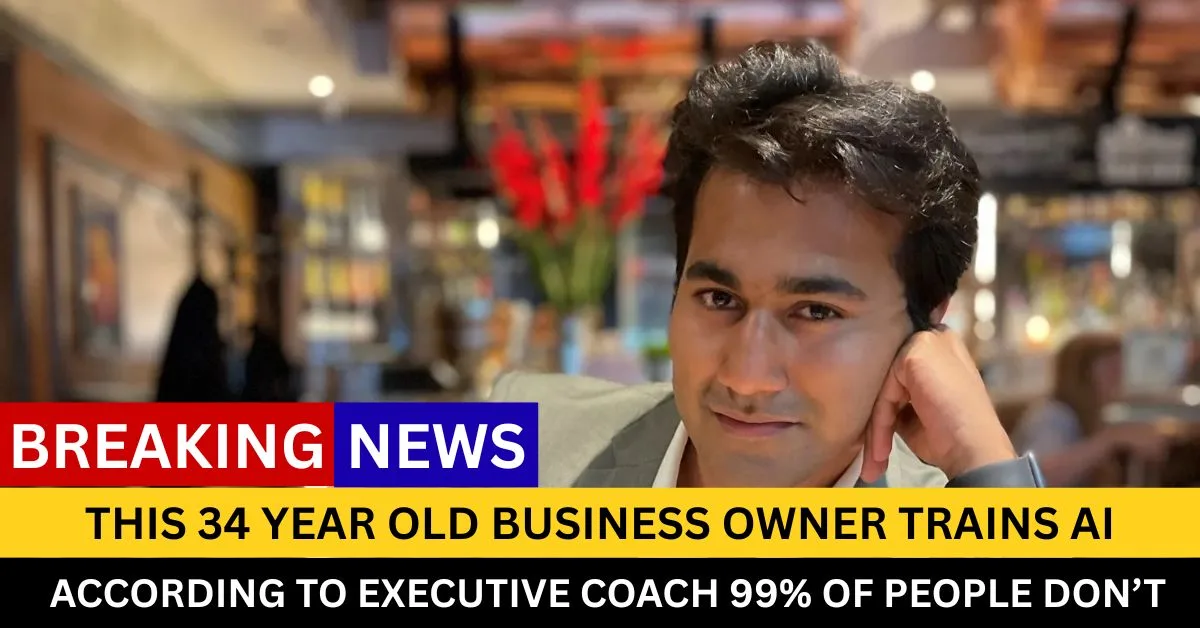
This 34-year-old business owner trains AI. Source: Utkarsh Amitabh
This 34-year-old business owner trains AI models as a side gig for $200 per hour
This 34-year-old business owner trains AI models as a side gig for $200 per hour. When data labeling startup micro1 approached Utkarsh Amitabh in January 2025 about joining its network of human specialists that assist businesses in training artificial intelligence models, he claims he was most definitely not looking for a new job.
The 34-year-old entrepreneur from the United Kingdom already had a packed schedule as an author, professor at universities, founder and CEO of Network Capital, a global mentorship and jobs platform, and a Ph.D. candidate at the University of Oxford’s Saïd Business School. He tells Indifact News Make It that he also had a newborn at home.
In the end, Amitabh accepted the additional position, acknowledging that “intellectual curiosity drew me in,” he claims. Given his background in “business strategy, financial modeling, and tech,” the idea of training corporate AI models seemed like a perfect fit, he continues.
In fact, according to micro1, it hires professionals with extensive expertise in a variety of fields, including engineering, medicine, and law. Amitabh, who describes himself as a “deep generalist,” certainly seems to suit the description.
He holds a master’s degree in moral philosophy and an undergraduate degree in mechanical engineering. He worked on business development for Microsoft for almost six years, specializing on cloud computing and AI collaborations. His previous works include a master’s thesis on how AI would impact the nature of achievement and a book on “the side-hustle revolution.”
According to Amitabh, the opportunity with micro1 looked like a “natural” fit. Additionally, he valued the flexibility of the part-time, freelance position. According to him, he works an average of 3.5 hours every night, usually after his 1-year-old daughter goes to bed.
Amitabh says, “This didn’t seem like an add-on, but something I could use to further my interests in a limited number of hours a week.” According to a pay stub that Indifact News Make It was able to obtain, Amitabh currently makes $200 per hour for his work training AI models for micro1. A company representative verified that Amitabh had made close to $300,000 for his work since January, including project completion bonuses.
However, Amitabh claims that “money was less of a motivator” than the role’s alignment with his personal and professional objectives, particularly in light of the fact that he already made a respectable living from his prior occupations. Nevertheless, he views “fair pay as a core value,” adding that he thought the salary was “respectable” for work requiring a high level of knowledge.
Also read: Do these 6 easy steps to be taken Startup seriously: According to executive coach, “99% of founders” don’t.
You must be extremely detail-oriented.
According to TechCrunch, since its founding in 2022, micro1 has amassed a network of over 2 million specialists who train AI models for clients including Fortune 100 companies creating their own huge language models for their separate workforces and major AI labs like Microsoft. Micro1’s most recent valuation was $500 million, and its rivals include bigger businesses like ScaleAI and Mercor.
“Today’s AI models have already absorbed most publicly available knowledge, and real progress now comes from domain experts who can challenge, refine and effectively outthink the model,” stated Daniel Warner, chief marketing officer of micro1, in a statement. “That network of experts like Amitabh forms the backbone of our data quality.” We are able to provide top-notch outcomes for top AI laboratories and the Fortune 100 thanks to the “human data” produced by genuine professionals.
In order to create a huge data set for AI model training, an algorithm must be fed a vast number of data and situations. The model is then improved over time by testing it with prompts that ask it to respond to queries or suggest fixes for issues. For instance, an AI agent might be asked to monitor spending, project growth, and develop a new budget for a business unit inside an organization.
“Looking at a complex business problem that a regular user, a business owner or an executive, might have, and then breaking down that problem into small parts” is how Amitabh describes many of the confidential projects he works on. He continues, “This part of the job requires him to break down each problem into clear, specific language that “machines will comprehend” in order to ensure the model can return an accurate and relevant response, much like prompt engineering.”
Amitabh looks for instances where “a point got missed or subtlety got lost” and fixes them so that the model’s data set can be modified and enhanced before testing it again if the model’s response contains mistakes or deviates too far from the original question or problem. According to him, each issue set can require “several hours” of trial and error.
You must be extremely detail-oriented and always watch out for errors that humans or machines might make. By immersing yourself in the process, you learn more about the types of errors that exist, according to Amitabh. According to Amitabh, the work is “intellectually quite demanding,” especially since the AI models are always growing and developing, necessitating that even experts like him advance their own knowledge base and capacity for original thought.
He continues, “The ultimate goal is actually really energizing.” “You’re observing whether the interaction between the machine and the human can level up the output for the problems you asked and other types of problems that might be related to it.”
“The trillion-dollar question” about AI and employment
Employees in most industries are worried about whether AI may eventually render human workers obsolete or drastically change their roles in the workplace. Does Amitabh fear that using his own skills to train AI models today will limit his future employment options or those of others with comparable backgrounds?
“This is the trillion-dollar question,” he says, pointing out that when it comes to how people perceive the upcoming AI revolution and its effects on the job market, most individuals fall into the category of “techno-optimists or techno-pessimists.” He continues, “I like to think of myself somewhere between a techno-optimist and a techno-realist.”
Amitabh acknowledges that there will undoubtedly be “growing-up pains” as more businesses integrate AI technologies into their employees’ daily tasks. This will probably lead to the loss of a sizable number of jobs, which human resources directors claim is already starting to occur.
He does, however, belong to the optimistic group that believes AI will eventually provide more jobs to somewhat offset those losses. For example, according to a World Economic Forum estimate from January 2025, AI will be a disruptive but ultimately positive force on the global labor market, leading to the creation of roughly 80 million net jobs by 2030.
In the end, Amitabh claims he adopts a more philosophical perspective: He is certain that knowledge in both humans and machines is not a “finite” resource and that there will always be a symbiotic relationship between the two, requiring ongoing cooperation for both to grow.
He adds, “I’m not worried about the [idea of] AI Doom entirely, because I think it does far more good than bad. It’s also possible that this collective fear of AI empowers us to learn better, upskill ourselves, and frame questions about ourselves differently.”
About The Author