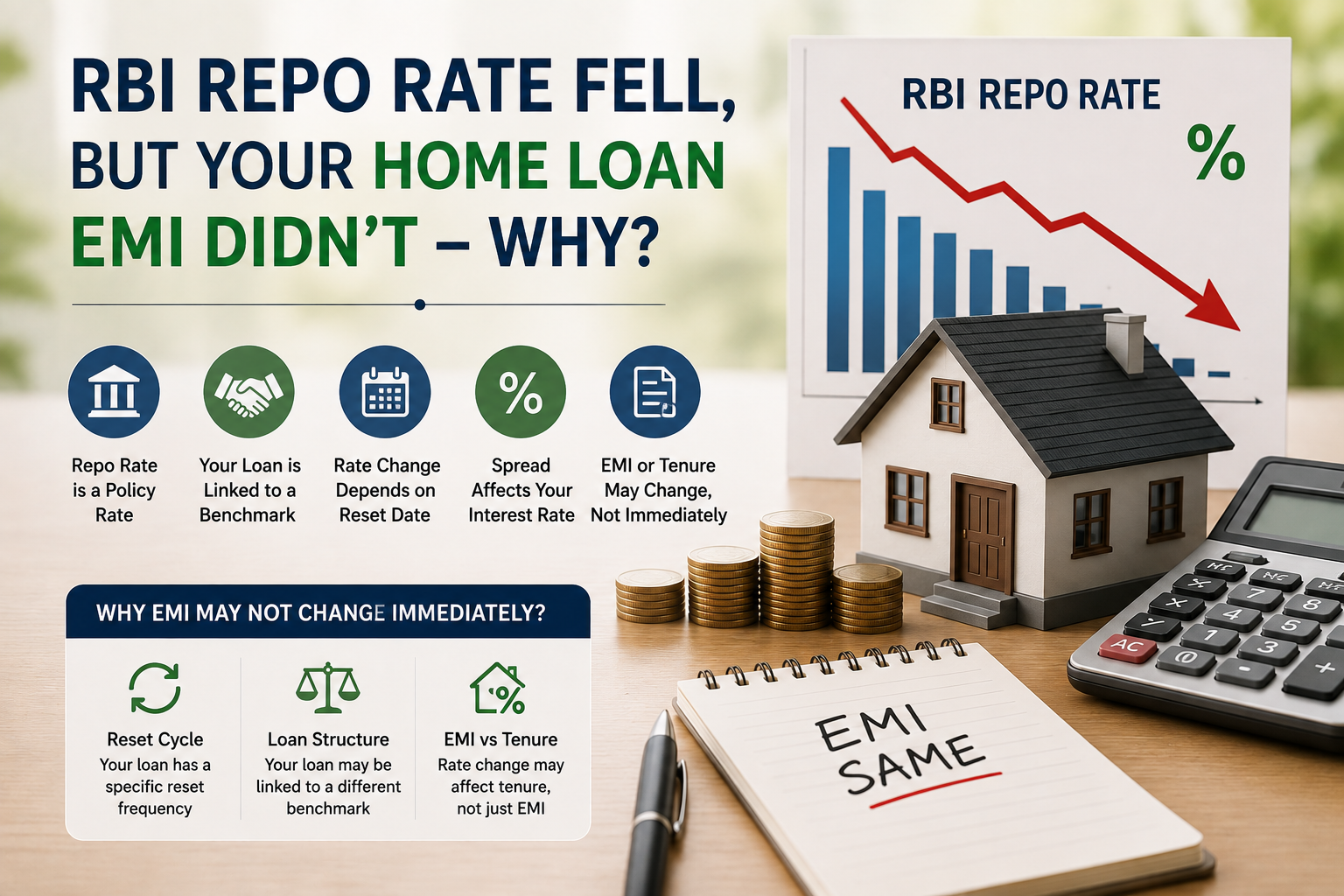
The RBI policy repo rate is currently 5.25% according to RBI’s published current-rates information.
So a borrower might reasonably ask:
“If the repo rate has fallen, why hasn’t my EMI fallen?”
The missing piece is that repo rate and your individual home-loan rate are not the same number.
What Is the Repo Rate?
In simplified terms, the policy repo rate is a key monetary-policy rate set by RBI.
Changes in it can influence interest rates across the financial system.
But this does not mean:
RBI cuts repo by 0.25% → every borrower’s EMI instantly drops by exactly 0.25%.
Your loan agreement matters.
Your Loan Has Its Own Benchmark and Pricing
A floating-rate home loan can be linked to a benchmark with an additional spread or margin according to the lender’s applicable framework.
For example, HDFC Bank’s current home-loan information states that its rates are benchmarked to the policy repo rate and that the final rate varies based on borrower-related factors.
Why You Might Not See an Immediate Change
Possible reasons include:
Reset timing: Your loan may have a defined interest-rate reset mechanism.
Loan structure: Different loans may be linked to different benchmarks depending on when and how they were originated.
EMI vs tenure: Depending on the loan arrangement and options, an interest-rate change may affect tenure rather than producing the EMI change a borrower expected.
Your specific pricing: Benchmark and borrower-specific spread should not be confused.
Example
Suppose a fictional borrower has:
Outstanding loan: ₹40 lakh
Remaining tenure: 15 years
If their applicable rate falls, the financial effect depends on how their lender applies the change under the loan terms.
Instead of assuming something is wrong, the borrower can ask:
- What benchmark is my loan linked to?
- What is my current applicable rate?
- What spread applies?
- What is my reset date/frequency?
- Will a rate change alter EMI, tenure, or another repayment parameter?
Don’t Make Decisions Based Only on RBI Headlines
A headline reading:
“RBI cuts repo rate”
is macroeconomic news.
Your home loan is a specific legal and financial contract.
Read your lender’s communication and loan documentation before assuming what the policy decision means for your EMI.
Final Takeaway
A repo-rate movement can influence borrowing costs, but the impact on an individual home loan depends on the loan’s benchmark, spread, reset structure and lender terms.
The useful question isn’t simply:
“Did RBI reduce rates?”
It is:
“How is my particular home loan linked to interest-rate changes?”