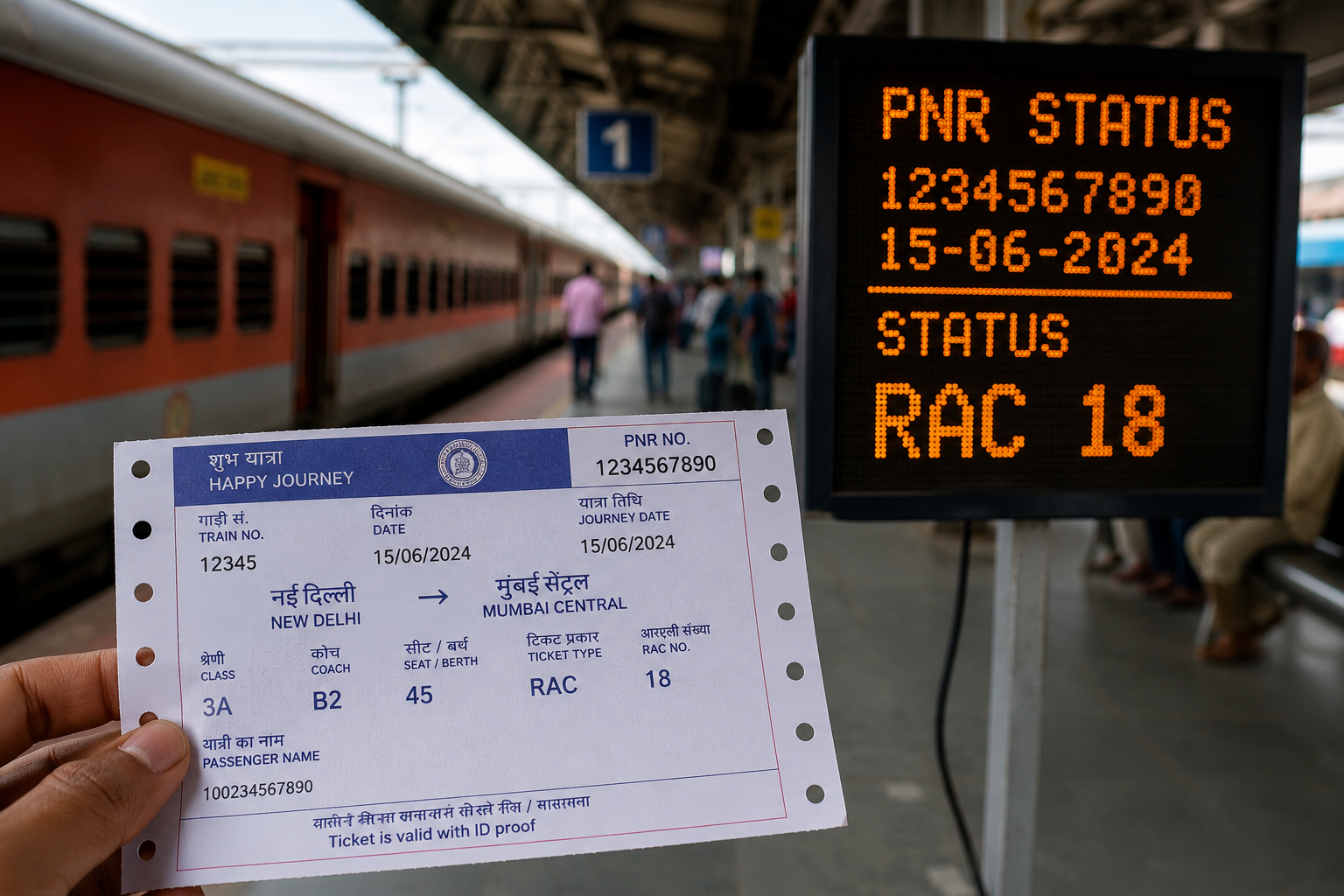
You booked a train ticket several weeks before departure. Your status is still RAC, but someone you know booked later and received a confirmed berth.
The immediate reaction is understandable:
“How did their ticket get confirmed before mine?”
Indian Railways reservation is more complex than one single waiting line. Different quotas, boarding points, routes, classes, cancellations, and seat availability can affect what passengers see.
Understanding this can make RAC and waiting-list statuses much less confusing.
First: What Does RAC Actually Mean?
RAC stands for Reservation Against Cancellation.
An RAC ticket is different from a regular waiting-list ticket.
An RAC passenger is generally permitted to travel in the reserved coach, but a full individual berth may not initially be allotted. Depending on availability and subsequent cancellations, the passenger may later receive a complete berth.
This is why seeing RAC 18 does not simply mean “17 people must cancel before I get a berth.”
The reservation system has several other factors to consider.
Why Isn’t Railway Booking Just First Come, First Served?
Imagine a train running:
Delhi → Agra → Gwalior → Jhansi → Bhopal
Passenger A books:
Delhi → Bhopal
Passenger B books later:
Agra → Gwalior
It might seem logical that Passenger A should always receive priority because the booking was made earlier.
But railway inventory isn’t necessarily that simple.
A berth can potentially be occupied by different passengers over different portions of the same journey.
For example, one passenger may use a berth from Delhi to Agra, while another passenger could potentially use it from Agra onward, subject to the railway’s reservation system and availability.
Therefore, the origin and destination of a journey matter.
1. Different Passengers May Be Booking Under Different Quotas
Not every seat on a train necessarily belongs to one common pool.
Indian Railways uses different reservation quotas for different categories and circumstances.
Depending on the train and applicable rules, these can include categories such as:
- General quota
- Tatkal quota
- Ladies quota
- Lower berth-related provisions
- Premium Tatkal on applicable trains
- Other authorized reservation quotas
This means two passengers travelling on the same train and date may not necessarily be competing for exactly the same inventory.
Simple Example
Suppose Passenger A books under the regular available quota and receives RAC.
Passenger B later finds availability under another applicable quota.
Passenger B receiving a confirmed berth does not necessarily mean they “jumped ahead” of Passenger A.
Their reservations may have been processed against different availability.
2. Your Boarding and Destination Stations Matter
This is one of the most overlooked reasons for apparently strange ticket statuses.
Consider this simplified example:
| Passenger | Journey | Booking Time | Status |
|---|---|---|---|
| A | Delhi → Bhopal | Earlier | RAC |
| B | Agra → Jhansi | Later | Confirmed |
| C | Jhansi → Bhopal | Later | Confirmed |
At first glance, passengers B and C receiving confirmed tickets after Passenger A looks unfair.
But B and C need berths for shorter and different sections of the train’s journey.
Railway reservation inventory can account for the sections over which accommodation is available.
So comparing only the train number and travel date isn’t enough.
You should also consider:
From where to where is each passenger travelling?
3. Remote Location Waiting Lists Can Behave Differently
A long-distance train may serve several important stations along its route.
Reservation availability can therefore be managed differently for passengers boarding at intermediate stations.
This is one reason passengers sometimes encounter different waiting-list categories rather than one universal WL status.
The probability and manner of confirmation can differ depending on the applicable waiting-list category and reservation availability.
4. A Cancellation Doesn’t Always Mean the Next RAC Passenger Instantly Gets a Full Berth
Suppose someone cancels a confirmed ticket.
It sounds straightforward:
One confirmed berth cancelled → first RAC passenger gets it.
In practice, the exact effect depends on the reservation circumstances.
The cancelled accommodation may relate to a particular journey segment, quota, boarding point, or other inventory condition.
The reservation system then processes available accommodation according to applicable railway rules.
Therefore, watching your RAC number after every cancellation isn’t a reliable way to predict exactly when you will receive a full berth.
5. Why Does RAC Sometimes Move Quickly Near Departure?
You may notice:
RAC 32 → RAC 27 → RAC 18 → RAC 8
with much of the movement happening closer to departure.
One obvious reason is cancellations.
Travel plans often change as departure approaches. Some passengers cancel confirmed bookings, while others change their journeys.
As accommodation becomes available, reservation statuses can move.
However, there is no fixed rule that RAC must improve by a particular number during the final 24 or 48 hours.
6. Chart Preparation Can Change the Picture
Before train departure, Indian Railways prepares reservation charts according to its applicable procedures.
This is an important stage because the system now has a clearer picture of reservations, cancellations, and available accommodation.
Some RAC passengers may receive full berths when accommodation becomes available.
This is why checking your ticket once immediately after booking and assuming that status will remain unchanged until departure can be misleading.
Always check the latest status closer to travel.
7. Vacant Berths Can Sometimes Appear During the Journey
Even after chart preparation, practical situations can occur where accommodation becomes available.
For example, a passenger may:
- Cancel according to applicable rules
- Not undertake the journey
- Travel only part of the booked route
- Have accommodation become available for another operational reason
Where permissible, vacant accommodation may be allotted according to railway procedures.
Passengers should speak with the authorized railway staff or Travelling Ticket Examiner (TTE) rather than simply occupying an apparently empty berth.
An empty-looking berth is not automatically available.
RAC vs Waiting List: Don’t Treat Them as the Same Thing
Passengers sometimes use “waiting ticket” to describe both RAC and WL.
They are not identical.
RAC
An RAC passenger generally has reservation status that permits travel in the reserved coach, subject to the applicable railway rules, although a complete individual berth may not initially be available.
Waiting List
A waitlisted passenger has not yet reached RAC or confirmed status.
The travel implications of a ticket that remains fully waitlisted can depend on factors including the ticket type and current railway rules.
Because these rules can be updated, passengers should check the latest status and official railway guidance before travelling.
Why Prediction Apps Cannot Guarantee Confirmation
Many websites and apps show something like:
“82% confirmation chance.”
Such figures can look reassuring, but they are predictions—not official confirmation.
Prediction systems may use historical patterns such as previous cancellations and status movements.
But historical behaviour cannot know exactly what passengers will do for your particular train tomorrow.
Unexpected demand, holidays, events, route changes, additional coaches, cancellations, and other operational factors can affect the final outcome.
A prediction can therefore be treated as an estimate, not a promise.
A Better Way to Think About Your RAC Ticket
Instead of asking:
“How many people are ahead of me?”
A more useful way to think about it is:
“What availability applies to my exact train, class, quota, boarding station, destination and travel date?”
Those details provide much more context than the RAC number alone.
Before making important travel decisions, check your latest booking status through official Indian Railways/IRCTC channels.
Practical Example
Imagine Rahul books a sleeper-class ticket from Station A to Station E and receives RAC.
Two days later, Priya books the same train from Station C to Station E and receives a confirmed berth.
Rahul might assume the system ignored his earlier reservation.
But Priya’s journey begins at a different station, and the available reservation inventory for her journey segment may differ from Rahul’s.
So:
Later booking ≠ automatically lower priority in every possible reservation situation.
That distinction explains many of the seemingly strange comparisons passengers make.
Final Takeaway
Indian Railways reservation status is not simply one giant queue where every cancellation moves the next passenger forward.
Quota, journey segment, boarding station, destination, class, reservation availability, cancellations, and chart preparation can all influence ticket status.
So if your RAC ticket remains unchanged while another passenger gets a confirmed berth, it doesn’t automatically mean something went wrong.
Compare the exact journey details, not just who booked first.
And most importantly, treat third-party confirmation predictions as estimates and rely on your current official ticket status when making travel decisions.
FAQs
Does RAC mean I can travel?
RAC generally provides reservation to travel subject to the applicable railway rules, although a full individual berth may not initially be allotted. Check the current official status and rules for your particular ticket before travelling.
Why did someone who booked after me get a confirmed ticket?
They may have a different boarding station, destination, quota, class, or applicable reservation inventory. Booking time alone does not explain every comparison.
Can RAC become confirmed after chart preparation?
Berth allocation can change as cancellations and available accommodation are processed. Check the latest official status close to departure.
Does RAC 10 mean exactly 10 cancellations are required?
Not necessarily. Reservation allocation involves more than a simple one-person-per-cancellation queue.
Are RAC confirmation percentages guaranteed?
No. Third-party confirmation probabilities are predictions. They should not be treated as a guarantee of a confirmed berth.