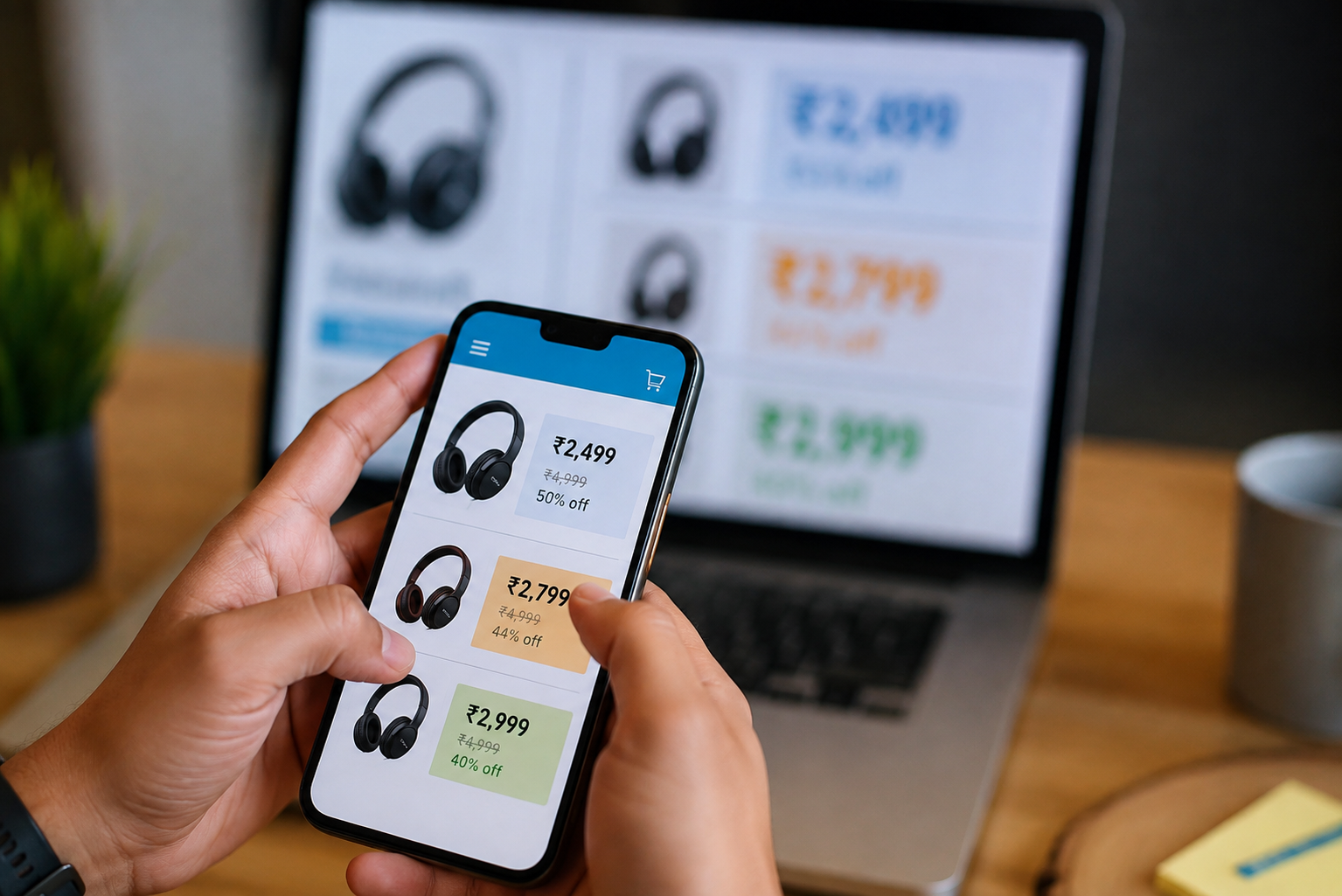
You search for a pair of headphones on one shopping app and see it for ₹2,499. The same model appears on another platform for ₹2,799, while a third shows ₹2,999 crossed out and offers it for ₹2,399 after a bank discount.
It is natural to wonder: if the product is exactly the same, why isn’t the price the same?
The answer is more interesting than simply “one website is cheaper.” Online prices can be influenced by the seller, inventory, location, promotions, payment method, delivery charges, and even when you check the product.
Understanding these differences can help Indian shoppers compare deals more accurately instead of automatically choosing the lowest number displayed on the screen.
One Product Doesn’t Always Mean One Seller
Large online marketplaces can have several independent sellers offering the exact same product.
Imagine a fictional wireless-earbuds model:
| Platform | Displayed Price | Seller | Delivery | Effective Cost |
|---|---|---|---|---|
| App A | ₹2,399 | Seller X | Free | ₹2,399 |
| App B | ₹2,299 | Seller Y | ₹99 | ₹2,398 |
| App C | ₹2,549 | Seller Z | Free | ₹2,549 |
At first glance, App B looks ₹100 cheaper than App A.
Once delivery is included, however, the actual difference is only ₹1.
This is why comparing only the large price displayed beside a product can sometimes give an incomplete picture.
1. Sellers Can Set Different Prices
A marketplace and a seller are not necessarily the same business.
Different sellers can have different purchase costs, inventory levels, operating expenses, margins, and promotional strategies.
One seller may be willing to accept a smaller margin to clear older inventory. Another may have recently purchased stock at a different wholesale price.
Therefore, two listings for the same model can legitimately have different prices.
For shoppers, the seller information can be almost as important as the price itself. Before purchasing, it is worth checking the seller, return conditions, warranty information, and whether the exact model or variant matches.
2. A “Discount” May Come From Several Places
Suppose a product has a listed selling price of ₹20,000.
You might encounter an offer like:
Selling price: ₹18,499
Bank-card discount: ₹1,500
Effective promotional price: ₹16,999
Another platform might simply list the product at ₹17,499 without requiring a particular card.
Which one is cheaper?
For someone who qualifies for the bank offer, the first deal could be better. For everyone else, the second could be cheaper.
This distinction matters because displayed promotional prices and prices available to every customer are not always the same thing.
3. Your Payment Method Can Change the Final Cost
E-commerce platforms frequently run promotions with banks, card networks, wallets, or other payment providers.
Depending on the specific promotion, a customer may encounter benefits for using an eligible:
- Credit card
- Debit card
- EMI transaction
- UPI payment
- Wallet
- Co-branded card
However, every offer can have its own conditions.
There may be a minimum transaction value, maximum discount, selected product eligibility, specific card requirement, or limited promotional period.
A headline such as “10% discount” therefore doesn’t necessarily mean every ₹30,000 purchase becomes ₹3,000 cheaper.
The actual terms matter.
4. Your Delivery Location Can Matter
A price comparison made in Mumbai may not always produce the same final buying experience as one made in a smaller town.
Your PIN code can affect factors such as:
- Which sellers can deliver to you
- Delivery fees
- Delivery speed
- Inventory availability
- Eligible fulfilment options
A particular seller may have inventory near one customer but may not serve another location.
This can result in another seller becoming the available option—with a different price.
So when comparing shopping apps, enter the actual delivery PIN code before assuming that a deal is available to you.
5. Inventory Can Influence Pricing
Consider a seller holding 1,000 units of a product that is about to receive a newer replacement model.
Keeping old inventory has a cost.
The seller might reduce the price to sell the remaining stock faster.
On another marketplace, a seller with fewer units—or different purchasing costs—may have no reason to make the same reduction.
This is one reason price differences can become particularly noticeable around:
- New model launches
- End-of-season periods
- Festival sales
- Clearance events
- Inventory changes
This doesn’t mean every price reduction is caused by inventory. It simply demonstrates why identical products do not necessarily follow identical pricing decisions.
6. Prices and Offers Can Change With Time
A product you checked on Monday may have a different price during a weekend sale.
Promotional campaigns begin and end. Seller inventory changes. Coupons become available or expire. Bank offers change.
This creates an important distinction between product price and temporary promotional price.
If you are buying an expensive non-urgent product, observing its price over several days can sometimes provide more context than making a decision from a single visit.
7. “₹5,000 Off” Doesn’t Automatically Mean It’s a Great Deal
Large discount percentages attract attention.
Imagine a product displaying:
MRP: ₹9,999
Sale Price: ₹4,999
50% OFF
The immediate impression is that the shopper is saving ₹5,000.
But the more useful question is:
What price does this product normally sell for?
If comparable listings have regularly been around ₹5,200, then ₹4,999 may still be a reasonable price—but it isn’t necessarily the extraordinary bargain the 50% figure appears to suggest.
MRP, current selling price, historical selling price, and final checkout price are different concepts.
8. Coupons Can Make Comparisons Surprisingly Complicated
Imagine two apps selling the same appliance:
App A: ₹14,499
App B: ₹14,999
App A initially appears cheaper.
But App B offers an eligible ₹1,000 coupon.
Its effective price becomes ₹13,999.
Now App B is cheaper—provided the shopper qualifies for and actually applies the coupon.
This is why a proper comparison should ideally happen at the checkout level, before payment, rather than solely on search-result pages.
9. Lowest Price Doesn’t Always Mean Best Purchase
Price matters, but a ₹200 saving may not always justify weaker purchase conditions.
Before buying, consider checking:
- Exact model number
- Storage, size, colour, or other variant
- Seller identity
- Product condition
- Manufacturer warranty
- Return/replacement policy
- Delivery date
- Installation charges, where relevant
- Final checkout amount
This is especially important for electronics and higher-value purchases.
Two listings that look identical in search results may differ in their exact specifications or after-sales conditions.
A Better Way to Compare Online Prices
Instead of asking only “Which app is cheapest?”, try asking:
“What will I actually pay for the exact same product under comparable conditions?”
A simple comparison can look like this:
Product price
+ delivery or mandatory charges
− coupons you genuinely qualify for
− applicable payment discounts
= approximate effective purchase cost
Then compare warranty, seller details, returns, and delivery conditions separately.
That gives you a much more meaningful comparison than a large “70% OFF” badge.
Final Takeaway
Different prices across shopping apps are not automatically suspicious.
Online marketplaces involve different sellers, inventories, promotions, payment partnerships, delivery conditions, and pricing decisions. As these factors change, the price visible to shoppers can change as well.
The useful habit is therefore not to chase the biggest discount percentage.
Compare the exact product, verify the seller and conditions, and look at the final amount you will actually pay.
A ₹2,299 listing isn’t necessarily cheaper than a ₹2,399 listing—and sometimes discovering that difference requires going all the way to the checkout page.
FAQs
Why is the same product cheaper on one shopping app?
It may be offered by a different seller, subject to a promotion, supported by different inventory economics, or accompanied by different delivery and payment conditions.
Do online prices change every day?
They can. Sellers and platforms may revise prices and promotions over time, although the frequency varies by product and marketplace.
Should I always buy from the platform showing the lowest price?
Not necessarily. Compare the exact model, seller, warranty, return conditions, delivery charges, and final checkout price as well.
Are bank discounts included in the displayed product price?
It depends on the platform and promotion. Some prices prominently advertise an effective amount that requires an eligible payment method. Always read the offer conditions.
Is a higher discount percentage always better?
No. A discount percentage is generally calculated against a reference price such as MRP. The final selling price and overall purchase conditions are more useful when comparing offers.